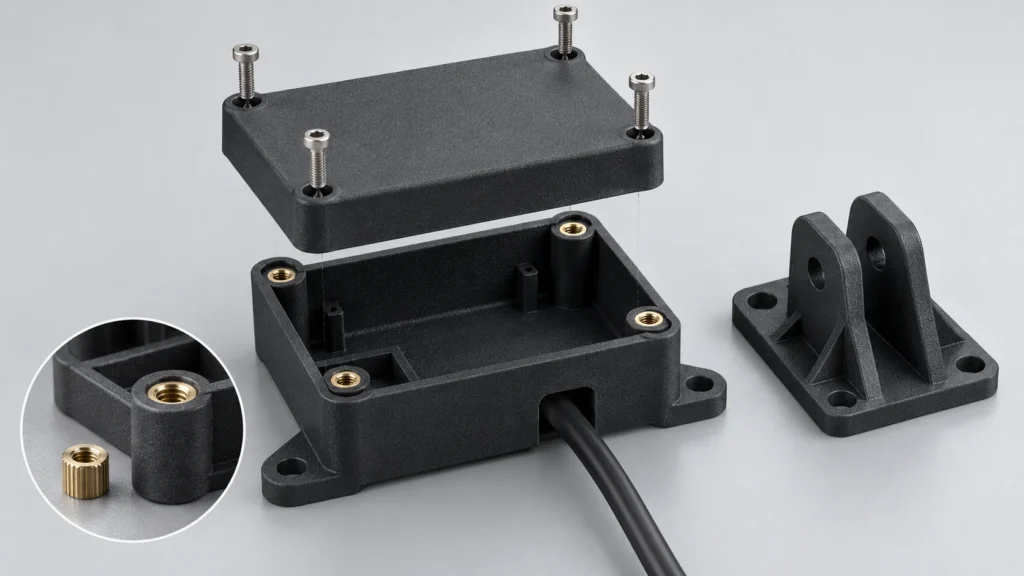
Example enclosure with a lid, metal inserts and a mounting feature. AI-generated concept illustration of assembly considerations, not a manufacturing drawing.
PA12, or polyamide 12, is a plastic used for functional 3D printed parts, including those made using MJF. It is worth considering for enclosures, brackets and other technical parts. However, the suitability of a particular print depends on more than the material name.
Instead of asking “is PA12 strong?”, ask a more precise question: what force must the part carry, at what temperature and for how long? This allows you to design the part and a test that reflect the actual task.
Strength and stiffness are different properties
A part may remain intact but deflect too much. In a camera bracket, that deflection can change image alignment even though the part has not broken. Conversely, a very stiff part may not withstand an accidental impact well.
Describe acceptable behaviour: no cracking, limited deflection, maintained spacing or repeated opening. Define a measurement method for critical requirements. “It looks sturdy” is not a useful batch acceptance criterion.
Is PA12 heat resistant?
There is no single safe temperature for every PA12 part. Check the type of parameter and test conditions in the specific material's data sheet. Heat deflection temperature is not automatically the permissible temperature for years of operation of the entire assembly.
For an electronics enclosure, specify the temperature at the mounting point, not just ambient temperature. Consider startup, continuous operation and heating while stopped. If data is missing, use the first version to help collect it.
Contact with water, oil and cleaning agents
Evonik highlights the mechanical and chemical resistance of its PA12 powders, but this does not make every printed part compatible with every substance. Specify the chemical, concentration, temperature and contact time. Wiping a cover and continuous immersion are different cases.
Do not assign an enclosure a specific sealing performance without testing the complete assembly. The lid joint, seal and cable entries are part of the same problem. The housing material is only one factor.
Surface finish, assembly and servicing
Separate visual expectations from functional requirements. If the part will be visible on the finished device, agree the surface appearance and finishing scope. If assembly matters most, identify datum surfaces, holes and mounting points.
A lid opened at every service visit needs a different joint design from a cover fitted once. Before choosing threads directly in the plastic or metal inserts, define disassembly frequency and joint loading. We discuss fits in more detail in our separate assembly guide.
How should you test PA12 before a larger production run?
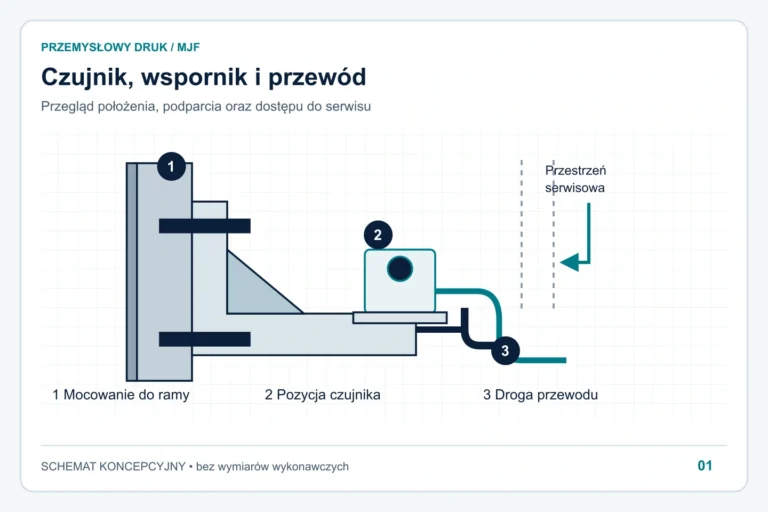
Prepare a test covering actual assembly and operating conditions. Record the model revision, tightening method and pass criteria. For a bracket, this may be allowable movement under load; for a lid, correct closing after service cycles.
After testing, record the required changes and approve the production version. This makes repeat orders and batch comparisons easier. Special properties such as ESD or a particular flammability rating require an agreed suitable material — the name “standard PA12” alone does not establish them.
Have a model to assess? Request a quote for MJF PA12 and describe the operating conditions. We also explain the distinction between material and technology in our guide to polyamides.