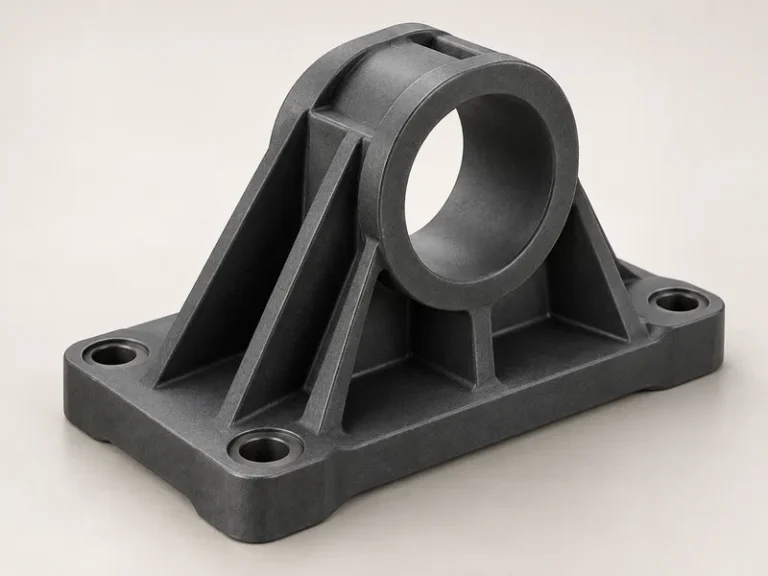
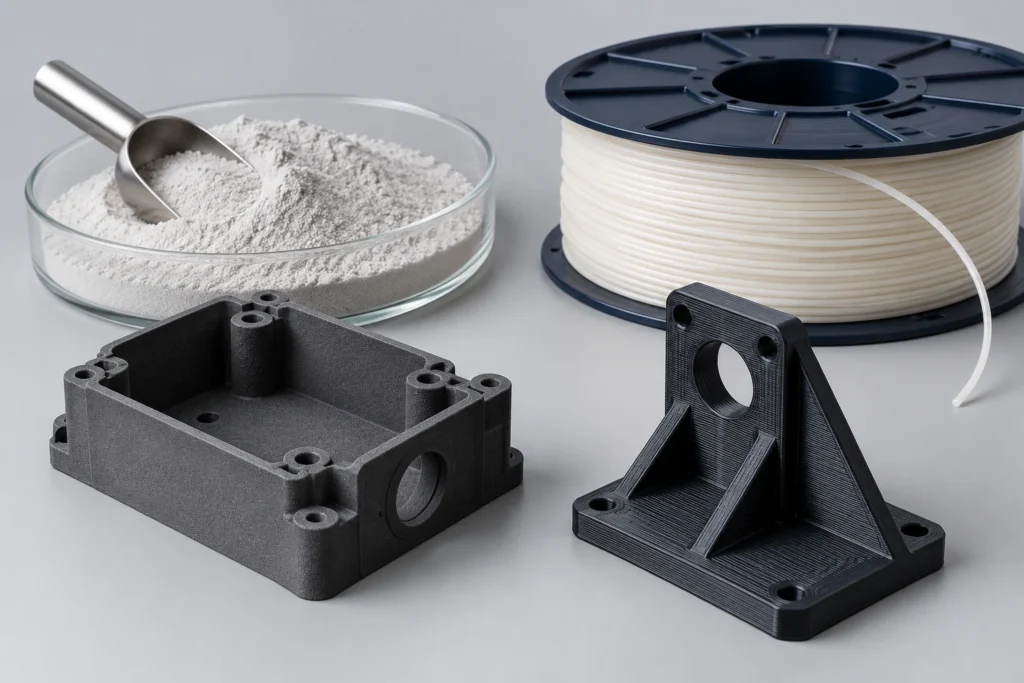
Polyamide powder and filament, with example parts showing different surface textures. AI illustration; appearance alone does not identify the PA grade.
Polyamide is a family of plastics abbreviated as PA. In 3D printing, you will also encounter the name nylon. It is not a single material formulation. Designations such as PA6, PA11 and PA12 distinguish polyamide types, while additional symbols may indicate fillers or reinforcement.
When ordering a part “in PA”, specify both the material grade and manufacturing method. It is similar to ordering something “in metal”: the information is useful, but too general to assess the finished part's properties.
PA12 and nylon 12 — are they the same material?
Both names refer to polyamide 12. That does not mean all commercial products or printed parts are identical. Each powder or filament has its own specification. The process, geometry and finishing also influence the result.
Evonik describes PA12 as a material for functional parts made using powder-based processes. Our MJF service focuses on PA12. Our separate guide to PA12 properties explains which questions to ask before selecting a material.
Which processes can print polyamide?
Polyamide can be a powder for processes such as MJF and SLS, or a filament for FDM/FFF. In the former, the part is built in a powder bed; in the latter, material is fed through a nozzle. The material family name alone therefore does not determine the print structure.
Do not apply test results for fibre-filled PA6 filament to an MJF PA12 part without verification. When comparing quotes, ask for the material name and technology for each one. Only then can requirements be meaningfully compared.
What do CF and GF mean?
CF usually indicates added carbon fibre, while GF indicates glass fibre. Other fillers, including glass beads, are also used. Do not treat these labels as a simple “good, better, best” scale. A change in formulation can improve one property while altering others.
A thin snap-fit needs to behave appropriately when flexed. For a bracket, stiffness may dominate. For a guide, friction and wear may be important. Select the material for the function, not simply for an impressive description.
Why does moisture matter?
Polyamides absorb moisture; its effect depends on the grade and conditions. Prusa highlights preparation and storage requirements for polyamide filaments. When assessing a finished part, consider its operating environment, especially where mating dimensions matter.
State whether the part operates in a dry room, is exposed to equipment washing or is used outdoors. “Water contact” can mean an occasional splash or prolonged immersion. These situations require different acceptance criteria.
What should you send for a polyamide part quote?
Along with the model and quantity, specify the part's function. Describe loading, temperature, contact with liquids and assembly requirements. If replacing a part, include its material and the reason for replacement. Cracking near a screw and insufficient cable space are two different design problems.
If the documentation specifies a particular PA grade, do not substitute another without agreement. If no material has been chosen, start with the operating conditions. Details of our service are available on the MJF PA12 printing page, or submit your project for individual advice.