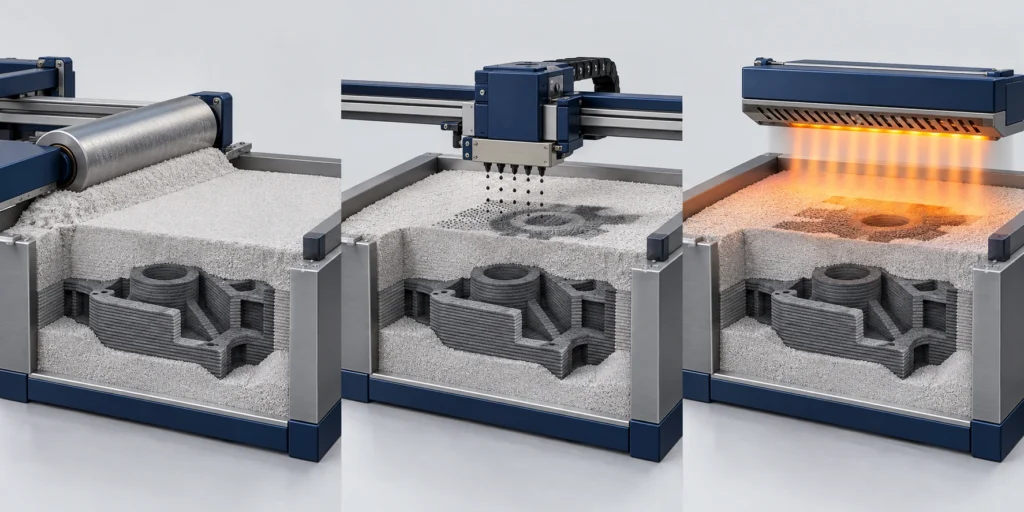
From left: spreading powder, applying a process agent and supplying thermal energy. Simplified AI illustration; layer thickness and droplets are enlarged for clarity. It does not depict the design of a specific HP printer.
MJF builds parts layer by layer from plastic powder, using process agents and thermal energy. Printing itself is only one stage of an order. The model and production must be prepared beforehand, and the parts must then be cooled and cleaned.
1. Start with the model and requirements
The file describes the geometry, but not every aspect of the application. The same hole might provide clearance for a screw or precisely locate a component. It is therefore useful to include a description or drawing identifying the requirements.
Before sending files, check units, part count and revision. A name such as “enclosure_final_3” does not replace a clear revision identifier. If you are ordering a body and lid, specify the number of sets and identify which files make up one set.
2. Plan the arrangement of parts
Production planning considers part orientation and arrangement within the build volume. This means that lead time and price do not depend solely on the weight of the finished print. Overall dimensions and the requirements of the particular geometry also matter.
If a surface is particularly important for appearance or dimensions, identify it before production starts. Do not leave that information until final inspection.
3. Spread powder and apply process agents
The printer applies an agent that promotes material fusion to the powder layer — fusing agent — and an agent that helps control the boundaries of the fused area, detailing agent. Thermal energy is then supplied. The material fuses in the areas corresponding to the model's cross-section. Successive layers form the solid part. MJF does not extrude filament paths or trace the cross-section with a laser.
4. Cool and unpack the parts
After the build, the parts need to cool and then be separated from the surrounding powder. The end of the printing cycle does not mean that the package is ready to ship. HP describes cooling and unpacking as separate process stages.
The order schedule should distinguish preparation, production, finishing and delivery. A project involving a first-part trial also requires time for evaluation and possible model revisions.
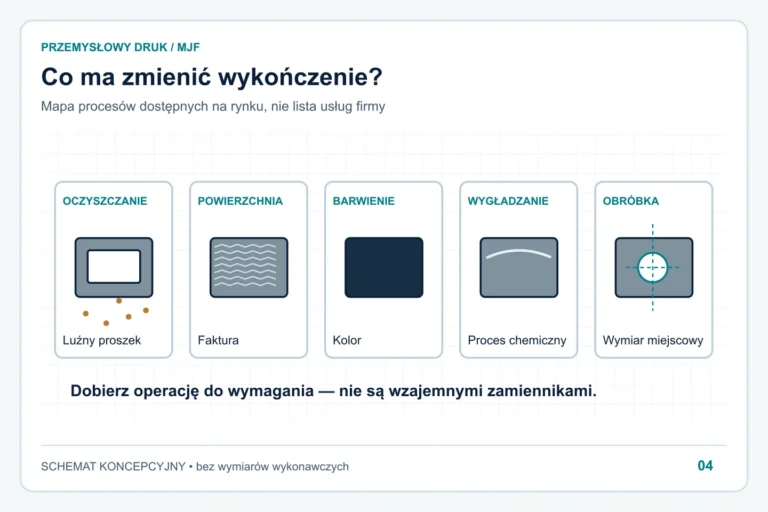
5. Clean and carry out agreed post-processing
Powder must also be removed from accessible holes and recesses. An enclosed chamber inside the model needs careful consideration: trapped material will not disappear after printing. The design must allow access for cleaning.
If you need inserts, tapping or hole finishing, include this in your enquiry. This is a separate scope of work that must be defined before the offer is confirmed. For threads, specify size, location and how the joint will be used; for inserts, also state assembly requirements.
6. Inspect against the agreed criteria
For a sensor housing, for example, you can agree to check the mounting points, connector clearance and lid joint. Before ordering a production run, approve the revision first. This reduces the risk of repeating a design error across multiple parts.
In our guide to fits we explain how to prepare parts for assembly. If you already have a model, open the MJF calculator. Include any additional requirements in the enquiry — the file alone does not define the full order scope.